Sure it's a beautiful weekend here in the Bay Area, but we're going to be spending some quality time inside (and not feeling the least bit guilty about it!).
Today we're heading out to see a double feature of White Mane and Paddle to the Sea at the Bay Area International Children's Film Festival. The festival promises a great line-up throughout the weekend, including two shorts programs presenting work from around the globe, and two animated features, Un Vie de Chat (France) and Light of the River (Japan). Tomorrow there's a wonderful sounding documentary about young people performing in the troupe Circus Smirkus, Taylor Signe's Circus Dreams.
Hope to see you at the movies!
Saturday, January 28, 2012


Tuesday, December 6, 2011
The Muppets & Your Local Art House Theater

Hilarious and heart-warming, but not in a cloying way,
The Muppets is great fun for the whole
family. As a longtime Muppet fan, I feared a new generation of writers could not live up to Jim Henson’s legacy and vision. Instead, I was pleasantly surprised
by their blend of '80s nostalgia and a modern comic sensibility. The film
feels very much like reuniting with old friends, just as it should, but goes beyond being a mere tribute piece or re-hashing of the familiar. The Muppets is actually clever and original—not what I expected from (gasp!) Disney.
My husband selected Oakland’s Grand Lake Theater
as our destination—an Art Deco theater that has been lovingly
maintained over the decades and still has its original ornate chandeliers,
frescoes, and tile work.
Sitting with my family in the theater brought to mind
something I haven’t touched on yet in this blog, which is my great love of
movie theaters. In a world of online streaming, portable devices, and giant flat screen
TVs, the way most of us watch movies has certainly changed over
the years. I am not opposed to watching movies at home. I love the convenience,
and sites like Netflix have given my family access to all kinds
of previously hard-to-find films.
But there’s something magical about going to the theater,
especially historic art houses like the Grand Lake. I love the
grandeur, and imagining all the generations before who have escaped into that
flickering world of the screen. Movie technology has evolved, but the
sensation of sitting in the dark, laughing and crying along with fellow
audience members—that experience remains timeless. Looking over at our kids’
beaming faces, wide-eyed and illuminated, I instantly re-connected with
something treasured from my own childhood, and felt the joy of sharing it.
After the movie, we walked to Lake Merritt for a little
bird-watching and went to lunch at a nearby restaurant, which leads me to the
other thing I really value about local art houses: Unlike multi-plexes,
the small theaters are part of the fabric of many communities. From small town
main streets to neighborhood shopping districts, art house theaters provide
culture, vibrancy, and a place where people come together.
Unfortunately, many smaller theaters are struggling to
survive. A couple of years ago, I wrote an
article on the plight of art house theaters, and I interviewed some folks
around the country who are working to save them. It’s an uphill battle, to
say the least, and they need all the help they can get.
So here’s an assignment for you: Go see The Muppets this holiday season. Bring your whole family, and if
you can, support a local, independent art house theater. And, oh yeah, don’t forget the popcorn!
Wednesday, November 23, 2011
The Muppet Movie (1979)

The verdict: A resounding yes, the film holds up, even if some of the jokes and puns are groan-inducing. All four of us were laughing throughout at classic slapstick and the antics of Jim Henson’s timeless characters—Animal (“Beat drums!”), the overgrown Sweetums, the charmingly unfunny stand-up comic Fozzie Bear (“Wokka, wokka!”), and the diva to end all divas, Miss Piggy. And then of course, there’s Kermit, whose rendition of “The Rainbow Connection,” sung upon a lily pad in the middle of a swamp, is one of the most enduring film images of my childhood (along with the famous scene of him riding a bicycle—how the heck did they do that?).
A road trip film, The Muppet Movie follows Kermit from his swamp to Hollywood, in search of fame and fortune. Along the way, a growing entourage of misfits and dreamers join in for the ride. One exception: Big Bird, whom they pass on the road going in the opposite direction, declines the offer of a ride and says he is going, “To New York, to make my big break in public television.” Ha-ha!
The Muppets share the screen with real people, and there is no distinction between cloth and flesh as far as characters go, except that the cloth ones seem to have more heart. Among the cameo appearances are Orson Welles, Bob Hope, Richard Pryor, Bernadette Peters, Dom Deluise and Steve Martin, who plays a sarcastic waiter in a particularly hilarious scene. The iconic puppeteer Edgar Bergen and sidekick Charlie McCarthy also appear in their last film before Bergen’s death.
And of course there is Charles Durning as the evil restaurateur Doc Hopper. Hopper wants Kermit to perform as spokesman for his frog legs franchise, and when Kermit refuses, a ruthless chase ensues. Hopper enlists an evil scientist (Mel Brooks) in a brain-zapper scene that was a bit scary for three-year-old George. But the scene ends with laughs as Miss Piggy mightily trounces the bad guys to save her beloved “Kermie.”
Parents should also note there is a scene with a gun-slinging villain named Snake Walker, who is evil personified, and who throws a giant spear-like fork at an image of Kermit. His bad-guy cronies, Hopper's henchmen, use guns during a frog target practice.
Our overall take: There is some violence that may be troubling to the preschool set, but because it is handled in a comic way, older kids (say, six and up) are unlikely to be bothered. The Muppet Movie is a sweet film that encourages everyone to follow their dreams, and underscores the importance of friendship along the way. And there are enough laughs and the nostalgia factor to make it entertaining for grown-ups as well as kids. We’ll definitely watch it again.
Tuesday, November 15, 2011
Alamar

Set in Banco Chinchorro, an endangered but naturally pristine coral reef in the Mexican Caribbean, Alamar centers on the relationship between a five-year-old boy (Natan) and his father (Jorge), who has taken him to live in a remote fishing village. Natan’s mom and Jorge, we learn through voice-over and an opening photo montage, are separating. Natan will ultimately live with his mother in Italy, but first will spend some quality time by the sea with Jorge and Matraca, an older friend of Jorge’s and a grandfatherly figure.
The film is in Spanish with subtitles, something I was concerned about with the kids. But the dialogue is sparse enough, and the story enchanting enough for children, that my three- and six-year-old were riveted the entire time and seemed unbothered by my reading subtitles to them.
Watching Alamar is very much like watching a documentary, and judging by the names of the cast, it seems that most characters are playing themselves. Natan really is Jorge’s son and the film seems to be a sort of hybrid between fact and fiction, giving it an emotional power. In one of the early scenes, we see Natan and Jorge on a motorboat on the way to the little house on piers where they will live. Natan is terribly seasick and his sympathetic father holds him lovingly. Throughout the film, the bond between them is evident and poignant.
There are many captivating scenes of life by the water. The men fish using spears and snorkels, and it is fascinating to watch them swimming underwater. One of the more surprising characters is a white egret, whom Natan names Blanquita. The bird arrives one day and sticks around, eating offerings from the fishermen and even climbing onto Jorge’s arm. According to notes I read about the film, Blanquita’s presence on the set was sheer luck, but she becomes an important part of the story, offering lessons about attachment and loss, and the potential for humans to connect with the natural world.
What is most notable about Alamar, as far as my kids go, is that very little happens. This is a good thing. There are no suspenseful scenes, no real danger or threat—just beautiful glimpses into a lifestyle and landscape that are little-known to us. There is love aplenty, and a sense of joy and discovery.
Knowing that the boy and his father would soon be separated gave the film an emotional depth that I appreciated. The kids were not so attuned to this, although it did spark some conversation about divorce with Pearl, my six-year-old. This was helpful as she has recently known friends whose parents are separating. It’s a hard topic for kids to understand, but the film makes clear that a parent’s love for a child can survive distance and separation. Jorge’s connection to Natan has a primordial quality to it—the bond between father and son seem as old and enduring as the sea itself.
I highly recommend this film for kids of all ages. Many thanks to my friend Annie’s mom, Lorna, for telling me about it!
Sunday, November 6, 2011
Dolphin Tale

While a 3-D version was released, we went for the 2-D version since we had three-year-old George along. He has only been to a movie theater once before, and the dark room and hugeness of the screen are stimulation aplenty for him. While the film is rated PG, I have to say I highly recommend it for all kids, even the young ones. In fact, I wonder why it was rated PG? I really didn’t see anything scary, sexy or troubling about it for young audiences. Go figure.
Dolphin Tale falls in the category of Hollywood inspirational tearjerker, a departure from some of the more artsy stuff I’ve been reviewing here. Despite being somewhat formulaic, I think the film was well done, with good acting and a plotline that definitely held all of our attention.
Dolphin Tale tells the story of a boy named Sawyer who comes upon a beached dolphin entangled in a crab trap. While waiting for a rescue team from a local aquarium to arrive, he develops a bond with the injured animal. Later he sneaks into the aquarium to check on his new friend, only to learn that the dolphin, named Winter by a girl whose Dad (Harry Connick, Jr.) runs the operation, won’t take food and is giving up. When Winter sees and hears Sawyer, however, she miraculously perks up, and so the boy becomes part of her rehabilitation.
It turns out that Winter also has a therapeutic effect on Sawyer—a picked-on loner who is failing school and spends his time tinkering in the garage workshop of his father, who has recently run off on the family. Sawyer’s loneliness is compounded by another loss—his beloved older cousin, a champion high school swimmer, has just been deployed to the Middle East. Tending to the injured dolphin, and developing a friendship with Hazel, the girl at the aquarium, Sawyer starts to become a happy and engaged child, a change noted by his supportive mother (Ashley Judd).
Along the way, some suspenseful plot twists arise. First, Winter’s tail becomes infected and must be amputated, possibly endangering her life. She survives and learns to swim tail-less, but it soon becomes obvious that the side-to-side motion she has adopted is going to destroy her spine, and ultimately end her life. About this time, Sawyer’s cousin returns home after a bomb blast partially paralyzes him. During a VA hospital visit, Sawyer meets a prosthetics specialist (Morgan Freeman) and enlists him in making a tail for Winter. However, the dolphin rejects the first two prosthetic devices, and it starts to seem as if all is lost. Then, there’s a hurricane! And the aquarium is up against financial ruin!
For the kids, Pearl and her friend Sasha (both six) and George (three), all of these setbacks definitely held their attention. The film shows that success doesn’t always come easily, and underscores that persistence and hard work can turn things around. It shows that grown-ups don’t always have the answers, and that with fresh minds and lots of energy, children can make a difference—a great message for kids to hear.
Talking with them about the plot, I realized afterwards that none of the kids understood that Sawyers’s cousin had been in a war, which I suppose was handled somewhat subtly. I think they also didn’t catch that Sawyer’s dad had disappeared, or that Hazel’s mom had passed away—all things alluded to in conversations between adults. I think this is fine. Ultimately what captured their hearts and attention were the friendship between Sawyer and Winter, and the story of kind humans working hard to help an injured animal—themes that I think most kids will embrace.
As for me, I was seriously choking back the tears on several occasions, but as I said in the beginning, I am a sucker for this stuff!
Monday, October 17, 2011
Willy Wonka and the Chocolate Factory
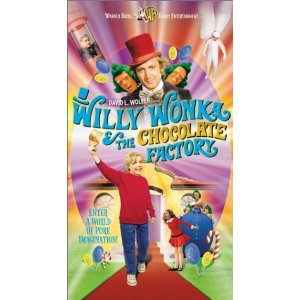
Well, I won’t let that diminish my happy memories of this film, which I recently revisited with George, Pearl and our seven-year-old friend Elliott. Forty years old this year, Willy Wonka and the Chocolate Factory still stirs the imagination and is every bit as weird and wonderful as I remembered it. Based on Roald Dahl’s novel Charlie and the Chocolate Factory, the film delves into some of the darker aspects of human nature, but is buoyed by energetic musical numbers and the clever and nuanced comedy of Gene Wilder as Willy Wonka.
A refresher on the plot: A good-natured boy named Charlie Bucket works to support his family, which includes four bedridden grandparents. When mysterious candy-maker Willy Wonka offers to admit five lucky people inside his factory, Charlie, like every child on the planet, becomes preoccupied with finding one of the “golden tickets” tucked inside a Wonka Bar. With hardly a penny to spare on chocolates, however, his odds seem slim.
Night after night, the TV news reports as the tickets are found, introducing a fantastic cast of despicable child characters: the gluttonous Augustus Gloop, the gum-smacking Violet Beauregarde, the screen-obsessed Mike Teavee, and the icon of rich, spoiled brattiness: Veruca Salt.
After a few suspenseful twists, Charlie finds the last golden ticket and runs home to show his family. On the way, an evil-looking man named Slugworth stops Charlie and promises to make him rich if he will bring him one of Wonka’s Everlasting Gobstoppers. At home, Grandpa Joe miraculously gets out of bed and agrees to join Charlie for the factory tour.
In addition to a prized look behind the scenes, Wonka offers the children a lifetime supply of chocolate, IF they abide by his rules during the tour. As the film progresses, each child meets his or her demise, as their true and terrible natures betray them. Even the lovable Charlie gives in to temptation at one point—but if rule-breaking and deception are inherent to the human existence, the film suggests that better intentions can sometimes rise above, and honesty can lead to redemption.
So, how did the kids like Willy Wonka and the Chocolate Factory? On the whole, they loved it. They were appropriately aghast at the behaviors of the “bad” children, which generated lots of comments, and they easily identified with Charlie, who has to be one of the most sympathetic characters in the history of film. Their favorite part of the movie was clearly the magical moment when the tour arrives at the factory’s interior, with its chocolate stream and everything edible and made of candy. A child’s dream come true!
However, there were a couple of scenes which made me realize this film is not ideal for very young viewers. One of these is the boat ride into the depths of the factory. As Wonka’s boat catapults through a tunnel, disturbing images pop up on the walls: a chicken getting its head cut off, a huge centipede crawling over a man’s face, and the like, as Gene Wilder sings a creepy song. Looking at this scene in light of current moviemaking, the effects seem endearingly clunky, and yet it still packs a punch for young viewers. All three had wide eyes, and three-year-old George ran from the room, thankfully missing most of this scene. I remember doing the same thing! So, if young kids are watching, a fast-forward is advised.
Also, watching each of the misbehaving kids get their comeuppance may be troubling, most notably Augustus Gloop disappearing into the chocolate river and being suctioned up into a tube. The film makes it clear that each kid is unharmed in the end, but still. The kids talked about the tube scene for a few days after.
My overall take: This was a fun film for me in terms of nostalgia and the kids enjoyed it, but I think it is probably more geared to slightly older kids. The site Common Sense Media recommends it for kids age eight and above, and that sounds about right to me too. We will definitely watch it again, but will probably wait a couple of years.
Monday, October 3, 2011
The Red Balloon

True to my memory, the film is magical. George and Pearl were quickly enchanted by the puppy-like antics of the balloon as it traipsed after young Pascal, following him home and later to school. There is virtually no dialogue, making it a very accessible international film.
Told through images, the storyline is both sweet and emotionally wrenching. Much as in Lamorisse’s White Mane, the child protagonist in The Red Balloon is portrayed as lonely and persecuted. The only image of his home life is of an angry mother casting his balloon out the window. Fortunately for Pascal, his balloon obediently waits outside for him. The scenes of his school show a cruel principal who locks Pascal up in a closet all day for bringing his balloon (it causes a distraction for the other children).
But by far the worst he must endure is a marauding pack of feral schoolboys who chase Pascal through the city’s mazelike streets and passageways, trying to destroy his balloon with rocks. In the end, they succeed in separating Pascal from the balloon and one boy hits the target with a slingshot. Slowly the balloon deflates and dies. These scenes were disturbing to all of us, but especially to three-year-old George—something parents of young kids may want to consider.
As sad as the balloon’s passing may seem, the film deals with issues that all kids face. Balloons pop, and throughout life, loss happens—both big and small. Sometimes we feel lonely and like no one is on our side. But I contend that the greatest works of children’s film and literature deal with these themes, as difficult as they are. The final scenes of the film are ultimately redeeming: Balloons from all over the city take flight and come to Pascal’s aid. The film’s last shot is truly uplifting, and I’ll leave it at that.
While dealing with some of life’s big themes, The Red Balloon’s premise is relatively simple, as are the special effects—a surprisingly believable simulation in which the balloon really does seem to move of its own accord. We had some discussion of how the filmmaker might have pulled this off (unseen wires?)—which made me realize that in more modern films where special effects are much more technical, we don’t often talk about how the film was made. Perhaps because I don’t even know! I liked this aspect of The Red Balloon, and it made me think about how we might someday try to make our own film with homemade special effects.
Visually, the film is stunning. The contrast of the bright red balloon and the gritty urban backdrop reflects Lamorisse’s cinematic prowess. The film also provides a fascinating documentation of mid-Century Parisian street life and an impoverished neighborhood of Ménilmontant that was mostly demolished in the decades following.
Want to watch it? The Red Balloon is available for purchase as part of the Criterion Collection. We checked it out from our local library.
Subscribe to:
Posts (Atom)