Showing posts with label Film Reviews. Show all posts

Saturday, February 23, 2013

Lotte from Gadgetville

A few weeks ago, we went to the Bay Area International Children’s Film Festival, an annual event in Alameda that features two full days of diverse, high quality movies for kids. We saw a delightful shorts program, with work from across the globe including some pieces by children—always inspiring for kids to see. Afterwards we watched the Estonian animated film Lotte from Gadgetville (English version), which was so unique and charming that I am breaking my long hiatus from this blog to write about it!

Directed by Heiki Ernits and Janno Poldma in 2007, Lotte from Gadgetville is the first animated feature film from Estonia and is considered a national treasure. The plot is offbeat, certainly compared to its American counterparts, about a town of animals where everyone is an inventor. Each year, the town holds a competition for the best invention. One day, some children find a book floating in the ocean near their home and inside is a Japanese bee named Susumu. He introduces the town to judo, which catches on like wildfire. So in addition to the invention competition and its preparation, the plot centers on a bee teaching judo to a village of animals. I’m telling you, it’s quirky!

The film’s lead character is a good-natured and spunky little girl dog named Lotte whose dad Oskar wins the competition every year. Lotte’s best friend, Bruno, is a boy cat who suffers from an overly-protective and domineering mother. We learn that Bruno’s dad disappeared, giving some insight into why Bruno’s mom won’t let him out of her sight. We see Lotte helping Bruno to push against the unreasonable limits set by his mom, and their frustration at times, as they strive to compete in a judo championship.

There is also some drama about a neighbor rabbit who cheats in the invention competition, desperate to win. He also has a back story which in the end makes him a bit more sympathetic, something I always appreciate in a film—showing that people are complicated and not necessarily good or bad, a refreshing perspective in children’s media.

Overall Lotte from Gadgetville is a story about friendship, sharing cultures, being courageous, and learning new skills. I would recommend it for kids of all ages, and their grown-ups!

And while you may think tracking down a six-year-old Estonian animated film an impossible task, I am happy to tell you that the film is actually available through Kidflix Global, where you can rent or buy the DVD. 

Thursday, July 5, 2012

Brave

Pearl, Grandma Karen, and I had a movie date this week to watch Brave, the perfect choice for an all-girl summer outing, although this is a movie that boys should enjoy too. We left three-year-old George at home primarily because the trailer showed some scary bear scenes. This was a good call, we all agreed, as the nightmarish Mor'du made his ferocious appearance onscreen.

The reviews for this film have been mixed, and some have criticized it for having a thin plot, or showing less innovation than Pixar's earlier works. What is notable, however, is that this is the first Pixar feature in 13 to have a female protagonist. What?! Yes, that is right, and it's about time, although the fact that the female lead is, of course, a princess, and serves to feed the Disney princess marketing behemoth, has also been the subject of criticism. No doubt, the predominance of princesses in films for girls continues to frustrate parents seeking alternative role models for their daughters. Peggy Orenstein's best-selling book Cinderella Ate My Daughter gives some context to this issue and is on my summer reading list.

Merida, the princess in Brave, however, effectively and refreshingly breaks the traditional mold, as a fiery, self-confident, daring young girl who is an expert archer and horseback rider. She delights in riding her trusty steed, Angus, through the Scottish highlands, and hitting targets with her bow and arrow. All the while, her magnificent mane of red curly locks billows around her with a life of its own, a wonder of animation in a film full of gorgeous scenes and expertly rendered details.

The film's main conflict develops when Merida's mother, Queen Elinor, tells her daughter that the time has come for her to marry, and that the first-born sons of her kingdom's clans are on their way to compete for her hand. The furious Merida refuses to play along, until she cleverly schemes up a way to win her own hand in marriage. After this plan fails, Merida looks to a witch for a spell that will change her mother, and let her pursue her own fate.

Her mother changes, but not in the way Merida had expected, and the girl's efforts must now turn to saving her mother, and ultimately the kingdom. This is the part where, to me, the film gets really interesting, in large part because it explores and actually gives some insight into the timeless, sometimes thorny, and complicated topic of mother-daughter relationships.

Queen Elinor has given her life to training her daughter in the feminine arts, knowing that she will one day take the throne. For the sake of the kingdom, whose clansmen expect that their sons will have a chance to share that throne, Elinor must offer her daughter's hand in marriage.  So, we see her strictness and insistence on bending her daughter's will as not simply cruel acts, but rooted in larger concerns and the responsibility she feels for the kingdom itself. A selfish break with tradition, we learn from a legend Elinor tells in the beginning, can lead to the demise of all. This is to say that Elinor is a more complex and sympathetic character than so many wicked mother and step-mother figures we've met in other stories.

As the story unfolds, compromise and the art of listening emerge as redemptive forces. The mother-daughter bond is threatened, but both Elinor and Merida go through major transformations that allow them to see each other in a new light. I actually found it quite moving.

The men and boys in the film serve mainly as comic relief: Merida's raucous and fun-loving father, King Fergus, seems more boy than man; her brothers, red-headed triplets, bounce around, impishly pursuing their own fun; and the clansmen, with their thick brogues and love of food, wine, and fisticuffs, play to every stereotype of ancient Scots you can imagine. The male characters in this film lack the depth and complexity found in Merida and Elinor, and  it seems Pixar is betting that's OK. The film targets a female audience, but boys who like a good fight scene will find satisfaction. Hopefully boys will also enjoy and be moved by the story of a girl determined to make her own way in the world. Merida is certainly struggling with issues that all young people encounter at some point.

I asked Pearl what she thought the main messages of the film were. She said, "To find strength inside yourself, to do what you want to do, and to be brave." I thought that was a pretty amazing take-away and I am happy for Pearl to have seen this film. Yes, this is a princess tale, but it has heart, and Merida serves as a perfect anti-Cinderella. For girls, this is definitely a step in the right direction.

If you go see Brave in the theater, be sure and arrive on time to catch the animated short La Luna, which precedes it. Directed by Enrico Casarosa and nominated for an Academy Award, it is a sweet story about a boy going out one night with his father and grandfather, whose job is to sweep stars on the moon's surface, changing its phase. With a simple but magical premise, and no words, the film, like Brave, sheds light on generational differences and a child's desire to do things his own way. A delightful short film!


Wednesday, July 4, 2012

The Secret World of Arrietty

The tooth fairy paid us a visit last week, leaving behind her usual gold dollar coin and a handwritten note. Sometimes the fairy leaves other signs of her visit: a pen set down in a different spot, or objects rearranged on the nightstand. I recently overheard Pearl and her friends comparing notes about such evidence. One time, Pearl’s friend Sasha saw footprints on her windowsill. According to Pearl, the tooth fairy is small enough to sit on your hand and lives in a glistening white castle made of teeth.

With tiny visitors on our minds, it seemed fitting to watch The Secret World of Arrietty, a story about a family of four-inch high “borrowers” who live beneath the floorboards of an old house.  The borrowers are so-named because they take things they need from human homes—a pin, a tissue, a cube of sugar. After we watched it, Pearl told me she understood now why small things sometimes go missing.

Based on Mary Norton’s 1952 novel, The Borrowers, The Secret World of Arrietty is the latest production from Japan’s Studio Ghibli, with a screenplay written by Hayao Miyazaki. The film features Studio Ghibli’s trademark stunning animation and careful attention to details, creating a magical world for the audience to enter.

In the film, we meet a boy named Sho, who is awaiting surgery for a heart condition. His parents, busy with their own lives, have left him to rest at his great aunt’s house in the country. Sho is a lonely, sad, and sickly character, but his life starts to change when he spies a tiny girl named Arrietty in the garden one afternoon. Despite her parents’ grave warnings, Arrietty communicates with Sho, and a friendship develops.

This friendship, however, puts Arrietty’s family at risk. A dwindling population, borrowers depend on secrecy for their survival, and discovery by humans has historically led to their demise. When Arrietty’s parents learn that a human knows of their existence, they are terrified and ready themselves to abandon the home they have lovingly built.

Arrietty and Sho’s innocent friendship leads to danger and upheaval, and the unfolding story kept us all (me, three-year-old George, six-year-old Pearl, and their dad) at the edge of our seats. Arrietty is an independent, clever and spunky character, a strong female lead, which I always appreciate. Her independence, however, is also her downfall, as she insists on disregarding her parents’ warnings. This makes her feel very real and all the more sympathetic as ultimately we see her striving to right the mistakes she has made. 

The Secret World of Arrietty is another testament to the brilliance of Miyazaki, a beautifully rendered, creative and entertaining film that will appeal to a broad range of viewers, from small kids to grown-ups.  It’s available now on DVD, so add it to your summer film viewing list. You’ll be glad you did.

And don’t be surprised if you or your kids start to notice evidence of small visitors in your own home. A lost coin or pen top might just mean there are borrowers afoot.

Saturday, May 19, 2012

Ponyo

After watching My Neighbor Totoro a while back, I started asking friends for recommendations of other Miyazaki films that would be good for a sensitive three-year-old and got two strong recommendations: Ponyo and Kiki’s Delivery Service.  So off to the video store I went.

(And here I will make a plug for an awesome video store called Five Star Video, the only video store left in Berkeley. They have a great selection of kids films, independent films, new releases and documentaries. A whole wall is dedicated to the Criterion Collection. So please pay a visit, and help keep them open!)

But I digress. We have just watched Ponyo and again, we’ve found a winner for the whole family. Like the classic story of The Little Mermaid, Ponyo spins a timeless, yet modern, tale of love between two worlds.

In the film, a five-year-old boy named Sosuke discovers a strange fish in the ocean near his home and names her Ponyo. When he cuts himself, Ponyo heals his cut with a kiss accidentally ingesting a small amount of Sosuke's blood, and putting herself on the road to transformation from fish to human.

Ponyo, child of an underwater wizard and the goddess of the sea, is a willful creature and unleashes her father’s magic to hasten her transformation. While turning Ponyo into a little girl, the magic spell also throws the world out of balance, pulling the moon perilously close to the earth and causing the ocean to rise and cover the earth’s surface.

There are some amazing, and somewhat alarming, scenes of Sosuke’s town being flooded, and his mother leaves him alone to go rescue people from the local senior center. But ultimately no one is harmed, and the flooded world is actually rather fun and interesting to Sosuke and Ponyo. The two cross town by boat in search of Sosuke’s mom, running into neighbors along the way, and watching fish swimming on the streets below. Ponyo performs several acts of magic, including blowing a toy boat up into a real boat, communicating telepathically with a baby, and walking on water. She is a wonderfully cheerful, enthusiastic and helpful girl, and Sosuke cherishes her.

But, of course Ponyo’s father is not keen on losing his daughter, and something must be done to put the world back in order and end the flood. Ultimately, Sosuke declares his love and acceptance of Ponyo as both a fish and a human, saving the day and making it all turn out right. Both children are great role models, and the parents in this film are caring and loving (although Ponyo’s dad comes across as a bit scary at times). The story has enough twists and turns, and is visually so interesting and beautiful, that it definitely qualifies as a film to please all ages. Our kids watched it twice and will definitely watch it again.

And, by the way, if you do watch it, and you stick around for the credits, you will have this going through your head for days:

Ponyo, Ponyo, Ponyo, fishy in the sea;
Tiny little fishy, who could you really be?
Ponyo, Ponyo, Ponyo, magic sets you free;
Oh she's a little girl with a round tummy.

One of the catchiest (and cutest) theme songs I've heard for a long while!

Wednesday, March 21, 2012

My Neighbor Totoro

“Wish I had a big friend like that,” said three-year-old George after watching My Neighbor Totoro. Yes, I thought, who wouldn’t want a friend like Totoro? He’s a big furry, bunny-like creature, endowed with magical powers, a forest spirit who never speaks a word, but offers protection to young children and other living creatures. And he flies, standing on a little spinning top that lifts him up above the trees. How cool is that?

Our whole family watched this film together, and we were all pretty enchanted. Directed by the Japanese animation master Hayao Miyazaki in 1988, this now-classic children’s film is visually gorgeous, with beautifully rendered scenes of the lush woods and pastoral landscape of rural Japan. The story follows two girls, Satsuki and her little sister Mei, who have just moved, with their father, into a decrepit country house at the edge of a forest.

A university professor, the father is gone for long stretches of the day, leaving the girls to make their own discoveries and have adventures. When at home, their father is a devoted and loving parent and there are many joyful scenes of family life. Their mother, however, is very sick and in the hospital—a plot line which was at times troubling as there was suggestion of her health declining.

But the overall sense of magic and happiness that fill this film override the few fear-inducing moments. For example, when the girls are first exploring their new house, they find it is over-run by "soot sprites"—mysterious black furballs that scurry across the floors and walls. These are spirits, like Totoro, seen only by the girls, but loud laughter easily dispatches with them. 

Totoro himself at first seems a bit alarming. Mei stumbles upon him at the base of a tree, in a nook protected by a briar patch. She mistakenly lands on his stomach while he is napping and he makes a loud growling and rumbling sound. But she soon realizes he is a friendly creature. Her father later tells her that Totoro is the “keeper of the forest.”

Far and away, the most magical and memorable part of this film for our kids was Totoro’s “Cat Bus”—a giant, bus-shaped feline with 12 legs who bounds across fields and nimbly walks along telephone lines. One evening when Mei is lost, the Cat Bus comes to Satsuki’s aid, inviting her inside and announcing, “Next stop: Little Sister!”

My Neighbor Totoro is a great film for kids of all ages, and grown-ups too. It portrays a loving family, and a sense of childhood discovery, fantasy, and the inner life of children. There is a message of respect for nature, and an overall gentleness about this film that is appealing. One thing I love is that there are no villains. So many children’s films rely on plots of good-guys-versus-bad-guys. My Neighbor Totoro offers a welcome departure from this tired formula with a well-told story and subtle yet compelling dramatic twists. We highly recommend!

Monday, February 20, 2012

Paddle to the Sea

A couple of weeks ago, the kids and I went with some friends to the Bay Area International Children's Film Festival. This was a great event! We’ll definitely go back next year—a diverse slate of movies, and really fun-sounding workshops for kids. The films are screened in a 1920s art deco theater in the strange no-man’s land of Alameda’s abandoned naval base. Not exactly an event one might stumble upon, so am glad to say we are now “in the know”—and you are too!

One of the films we took in was Paddle to the Sea, William Mason’s Academy Award-nominated short about the adventures of a wooden boat.

This 1966 children’s film classic was shown in classrooms throughout the ‘70s and ‘80s. While I don’t remember seeing it personally, I recognized the narrator’s voice in an instant as the voice of countless educational films from my own childhood. Now I realize it wasn’t the same narrator, of course, but there’s a certain quality to the voice—if you heard it, you’d see what I mean.

Many viewers will appreciate the retro educational film vibe, but Paddle to the Sea in fact offers much more, especially given its deceptively simple premise. The film stars a toy boat, an inanimate object that actually becomes heroic before our eyes. The story begins one winter when a Canadian Indian boy, living in a remote cabin, carves the boat out of wood and writes on the bottom: PADDLE TO THE SEA. PLEASE PUT ME BACK IN THE WATER. He places it on a hill, and in the spring when the snow begins to melt, Paddle to the Sea slides down the hill to a creek. So begins an epic journey, passing through the Great Lakes, Niagara Falls, and ultimately to the Atlantic Ocean.

Mason's camera follows as Paddle to the Sea bobs along, through seasons and changing locations. The boat survives a forest fire, a ship’s propellers, and the toxic sludge of Detroit’s polluted waterways. Various animals interact with the boat, including birds, a water snake, and a frog who uses the boat to escape the jaws of a hungry fish. These scenes are quite magical, and left me wondering how many hours of film they must have shot to get these “non actors” to perform so perfectly.

Paddle to the Sea also meets a few humans along the way—in one scene a delighted little boy picks up the boat and then sets it down in the water to float. When the boat moves beyond his reach, the boy commands his dog to fetch it, and the dog refuses.  When others find the boat, they are also delighted, but then read the maker’s instructions to put it back in the water, and they obey.

While Paddle to the Sea features some stunning imagery, what really makes this film a classic is the power of the idea behind it—that a boy can have a dream, and that nature (the unstoppable flow of water running downstream) and humans (those kind-hearted people whom the boat meets along the way) can help that dream be realized. The film imparts a sense of wonder in the natural world, and a sense of benevolent forces at work. I found it uplifting, and the kids? They loved it! In fact, Pearl noticed me working on this entry and asked if she could write a review herself, which she did.

Ready to watch Paddle to the Sea? The 28-minute film is available for download from Canada’s National Film Board.  Or you can purchase the DVD from the Criterion Collection.

Wednesday, February 1, 2012

Fantastic Mr. Fox

When I found out that one of my favorite directors had made an animated version of the children's story Fantastic Mr. Fox a couple years back, I was intrigued to say the least. After watching this film for the third time recently, I must say it is one of my all-time favorites. Fortunately the kids like it too, so it’s one of those rare films that our whole family can happily watch again and again… and undoubtedly again!

Director Wes Anderson (Bottle Rocket, Rushmore, The Royal Tenenbaums, etc.) applies his signature style and sensibility in this re-telling of the classic tale by Roald Dahl (Charlie and the Chocolate Factory, James and the Giant Peach). The stop-motion animation has a crafty, hand-made look to it, and features Anderson’s visual aesthetic—each shot is artfully composed, uncluttered, but with clever attention to small details.

The soundtrack is also reminiscent of Anderson’s other films, a mix of classic rock (Rolling Stones, Beach Boys) along with some wonderful Burl Ives songs and quirky—often hilarious—original compositions. And Anderson employs several regulars from his previous films, including Owen Wilson, Jason Schwartzman, and Bill Murray—so there's much to please diehard Wes Anderson fans.

The film stars George Clooney in the title role and Meryl Streep as Mrs. Fox. A newspaper columnist and reformed chicken thief, Mr. Fox presents a complicated character. Upwardly mobile, he wants to provide the best for his wife and son, Ash, a discontented, underachieving high school student. A real estate agent sells him a home in a tree, a considerable step up from a fox’s hole in the ground, and from there, the problems begin.

From their new abode, the Fox family has a clear view of three local farms owned respectively by Boggis, Bunce, and Bean. Remembering the excitement of his past life, Mr. Fox enlists an opossum friend to help him steal some chickens from one of the farms. This “one last big job” quickly turns into a triple-header as Fox can't resist hitting up all three farms.

Meanwhile, the Foxes' nephew, Kristofferson, comes to stay with the family. Unlike Ash, Kristofferson excels at sports, knows martial arts, and exudes a calm coolness. From day one, the misfit Ash resents his cousin, and the tension mounts.

Ultimately, Mr. Fox’s greed and secrecy put his family, and the entire animal community, at risk. There are some tense chase scenes, which are all peppered with enough humor to keep them from being really scary. There are also personal conflicts to be ironed out—between kids, between husband and wife, and between neighbors—along with some existential soul searching that should ring familiar to many hitting the middle years of life. 

All in all, there’s a lot packed into this beautifully crafted film about a bunch of cute animals, and a lot to appeal to grown-ups and kids alike. We highly recommend!

Tuesday, December 6, 2011

The Muppets & Your Local Art House Theater

Right after Thanksgiving, our whole family ventured out for a much-anticipated event: The Muppets had just opened in theaters, and we wanted to be among the first to take it in. I’ll tell you right now, you have to see this movie!

Hilarious and heart-warming, but not in a cloying way, The Muppets is great fun for the whole family. As a longtime Muppet fan, I feared a new generation of writers could not live up to Jim Henson’s legacy and vision. Instead, I was pleasantly surprised by their blend of '80s nostalgia and a modern comic sensibility. The film feels very much like reuniting with old friends, just as it should, but goes beyond being a mere tribute piece or re-hashing of the familiar. The Muppets is actually clever and original—not what I expected from (gasp!) Disney.

My husband selected Oakland’s Grand Lake Theater as our destination—an Art Deco theater that has been lovingly maintained over the decades and still has its original ornate chandeliers, frescoes, and tile work.

Sitting with my family in the theater brought to mind something I haven’t touched on yet in this blog, which is my great love of movie theaters. In a world of online streaming, portable devices, and giant flat screen TVs, the way most of us watch movies has certainly changed over the years. I am not opposed to watching movies at home. I love the convenience, and sites like Netflix have given my family access to all kinds of previously hard-to-find films.

But there’s something magical about going to the theater, especially historic art houses like the Grand Lake. I love the grandeur, and imagining all the generations before who have escaped into that flickering world of the screen. Movie technology has evolved, but the sensation of sitting in the dark, laughing and crying along with fellow audience members—that experience remains timeless. Looking over at our kids’ beaming faces, wide-eyed and illuminated, I instantly re-connected with something treasured from my own childhood, and felt the joy of sharing it.

After the movie, we walked to Lake Merritt for a little bird-watching and went to lunch at a nearby restaurant, which leads me to the other thing I really value about local art houses: Unlike multi-plexes, the small theaters are part of the fabric of many communities. From small town main streets to neighborhood shopping districts, art house theaters provide culture, vibrancy, and a place where people come together.

Unfortunately, many smaller theaters are struggling to survive. A couple of years ago, I wrote an article on the plight of art house theaters, and I interviewed some folks around the country who are working to save them. It’s an uphill battle, to say the least, and they need all the help they can get.

So here’s an assignment for you: Go see The Muppets this holiday season. Bring your whole family, and if you can, support a local, independent art house theater.  And, oh yeah, don’t forget the popcorn!

Wednesday, November 23, 2011

The Muppet Movie (1979)

With a new Muppet movie coming out this month, my husband and I were inspired to introduce one of our childhood favorites to the kids: the original 1979 The Muppet Movie. We both had fond memories, but would it stand the test of time? And would our kids like it too?

The verdict: A resounding yes, the film holds up, even if some of the jokes and puns are groan-inducing. All four of us were laughing throughout at classic slapstick and the antics of Jim Henson’s timeless characters—Animal (“Beat drums!”), the overgrown Sweetums, the charmingly unfunny stand-up comic Fozzie Bear (“Wokka, wokka!”), and the diva to end all divas, Miss Piggy. And then of course, there’s Kermit, whose rendition of “The Rainbow Connection,” sung upon a lily pad in the middle of a swamp, is one of the most enduring film images of my childhood (along with the famous scene of him riding a bicycle—how the heck did they do that?).

A road trip film, The Muppet Movie follows Kermit from his swamp to Hollywood, in search of fame and fortune. Along the way, a growing entourage of misfits and dreamers join in for the ride. One exception: Big Bird, whom they pass on the road going in the opposite direction, declines the offer of a ride and says he is going, “To New York, to make my big break in public television.” Ha-ha!

The Muppets share the screen with real people, and there is no distinction between cloth and flesh as far as characters go, except that the cloth ones seem to have more heart. Among the cameo appearances are Orson Welles, Bob Hope, Richard Pryor, Bernadette Peters, Dom Deluise and Steve Martin, who plays a sarcastic waiter in a particularly hilarious scene. The iconic puppeteer Edgar Bergen and sidekick Charlie McCarthy also appear in their last film before Bergen’s death.

And of course there is Charles Durning as the evil restaurateur Doc Hopper. Hopper wants Kermit to perform as spokesman for his frog legs franchise, and when Kermit refuses, a ruthless chase ensues. Hopper enlists an evil scientist (Mel Brooks) in a brain-zapper scene that was a bit scary for three-year-old George. But the scene ends with laughs as Miss Piggy mightily trounces the bad guys to save her beloved “Kermie.”

Parents should also note there is a scene with a gun-slinging villain named Snake Walker, who is evil personified, and who throws a giant spear-like fork at an image of Kermit. His bad-guy cronies, Hopper's henchmen, use guns during a frog target practice.

Our overall take: There is some violence that may be troubling to the preschool set, but because it is handled in a comic way, older kids (say, six and up) are unlikely to be bothered. The Muppet Movie is a sweet film that encourages everyone to follow their dreams, and underscores the importance of friendship along the way. And there are enough laughs and the nostalgia factor to make it entertaining for grown-ups as well as kids. We’ll definitely watch it again.

Tuesday, November 15, 2011

Alamar

Every once in a while you come across a film that delivers on the promise of cinema, a film that transports you to another world, that reveals something deep and true about the human condition, and that shows a mastery of the art and craft of filmmaking. Right now for me, that film is Pedro González-Rubio’s Alamar (To the Sea).

Set in Banco Chinchorro, an endangered but naturally pristine coral reef in the Mexican Caribbean, Alamar centers on the relationship between a five-year-old boy (Natan) and his father (Jorge), who has taken him to live in a remote fishing village. Natan’s mom and Jorge, we learn through voice-over and an opening photo montage, are separating. Natan will ultimately live with his mother in Italy, but first will spend some quality time by the sea with Jorge and Matraca, an older friend of Jorge’s and a grandfatherly figure.

The film is in Spanish with subtitles, something I was concerned about with the kids. But the dialogue is sparse enough, and the story enchanting enough for children, that my three- and six-year-old were riveted the entire time and seemed unbothered by my reading subtitles to them.

Watching Alamar is very much like watching a documentary, and judging by the names of the cast, it seems that most characters are playing themselves. Natan really is Jorge’s son and the film seems to be a sort of hybrid between fact and fiction, giving it an emotional power. In one of the early scenes, we see Natan and Jorge on a motorboat on the way to the little house on piers where they will live. Natan is terribly seasick and his sympathetic father holds him lovingly. Throughout the film, the bond between them is evident and poignant.

There are many captivating scenes of life by the water. The men fish using spears and snorkels, and it is fascinating to watch them swimming underwater. One of the more surprising characters is a white egret, whom Natan names Blanquita. The bird arrives one day and sticks around, eating offerings from the fishermen and even climbing onto Jorge’s arm. According to notes I read about the film, Blanquita’s presence on the set was sheer luck, but she becomes an important part of the story, offering lessons about attachment and loss, and the potential for humans to connect with the natural world.

What is most notable about Alamar, as far as my kids go, is that very little happens. This is a good thing. There are no suspenseful scenes, no real danger or threat—just beautiful glimpses into a lifestyle and landscape that are little-known to us. There is love aplenty, and a sense of joy and discovery.

Knowing that the boy and his father would soon be separated gave the film an emotional depth that I appreciated. The kids were not so attuned to this, although it did spark some conversation about divorce with Pearl, my six-year-old. This was helpful as she has recently known friends whose parents are separating. It’s a hard topic for kids to understand, but the film makes clear that a parent’s love for a child can survive distance and separation. Jorge’s connection to Natan has a primordial quality to it—the bond between father and son seem as old and enduring as the sea itself.

I highly recommend this film for kids of all ages. Many thanks to my friend Annie’s mom, Lorna, for telling me about it!

Sunday, November 6, 2011

Dolphin Tale

I am a sucker for animal movies, so when I saw a trailer for Dolphin Tale, and found my eyes misting at the very idea of it, I knew this was one I needed to see with the kids. So we went last week, actually making it to the theater on the last day it screened.

While a 3-D version was released, we went for the 2-D version since we had three-year-old George along. He has only been to a movie theater once before, and the dark room and hugeness of the screen are stimulation aplenty for him. While the film is rated PG, I have to say I highly recommend it for all kids, even the young ones. In fact, I wonder why it was rated PG? I really didn’t see anything scary, sexy or troubling about it for young audiences. Go figure.

Dolphin Tale falls in the category of Hollywood inspirational tearjerker, a departure from some of the more artsy stuff I’ve been reviewing here. Despite being somewhat formulaic, I think the film was well done, with good acting and a plotline that definitely held all of our attention.

Dolphin Tale tells the story of a boy named Sawyer who comes upon a beached dolphin entangled in a crab trap. While waiting for a rescue team from a local aquarium to arrive, he develops a bond with the injured animal. Later he sneaks into the aquarium to check on his new friend, only to learn that the dolphin, named Winter by a girl whose Dad (Harry Connick, Jr.) runs the operation, won’t take food and is giving up. When Winter sees and hears Sawyer, however, she miraculously perks up, and so the boy becomes part of her rehabilitation.

It turns out that Winter also has a therapeutic effect on Sawyer—a picked-on loner who is failing school and spends his time tinkering in the garage workshop of his father, who has recently run off on the family. Sawyer’s loneliness is compounded by another loss—his beloved older cousin, a champion high school swimmer, has just been deployed to the Middle East. Tending to the injured dolphin, and developing a friendship with Hazel, the girl at the aquarium, Sawyer starts to become a happy and engaged child, a change noted by his supportive mother (Ashley Judd).

Along the way, some suspenseful plot twists arise. First, Winter’s tail becomes infected and must be amputated, possibly endangering her life. She survives and learns to swim tail-less, but it soon becomes obvious that the side-to-side motion she has adopted is going to destroy her spine, and ultimately end her life. About this time, Sawyer’s cousin returns home after a bomb blast partially paralyzes him. During a VA hospital visit, Sawyer meets a prosthetics specialist (Morgan Freeman) and enlists him in making a tail for Winter. However, the dolphin rejects the first two prosthetic devices, and it starts to seem as if all is lost. Then, there’s a hurricane! And the aquarium is up against financial ruin!

For the kids, Pearl and her friend Sasha (both six) and George (three), all of these setbacks definitely held their attention. The film shows that success doesn’t always come easily, and underscores that persistence and hard work can turn things around. It shows that grown-ups don’t always have the answers, and that with fresh minds and lots of energy, children can make a difference—a great message for kids to hear.

Talking with them about the plot, I realized afterwards that none of the kids understood that Sawyers’s cousin had been in a war, which I suppose was handled somewhat subtly. I think they also didn’t catch that Sawyer’s dad had disappeared, or that Hazel’s mom had passed away—all things alluded to in conversations between adults. I think this is fine. Ultimately what captured their hearts and attention were the friendship between Sawyer and Winter, and the story of kind humans working hard to help an injured animal—themes that I think most kids will embrace.

As for me, I was seriously choking back the tears on several occasions, but as I said in the beginning, I am a sucker for this stuff!

Monday, October 17, 2011

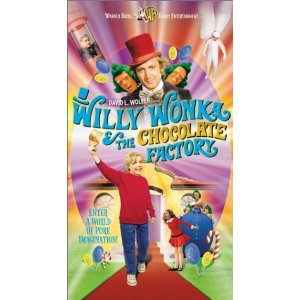
Willy Wonka and the Chocolate Factory

The things you learn when you do an Internet search—like that Willy Wonka and the Chocolate Factory, Mel Stuart’s 1971 classic, was financed by Quaker Oats to promote a new chocolate bar. Hey, come to think of it, I remember those Wonka Bars (and Gobstoppers, and probably a few others) from my 1970s childhood, and now I realize it was all part of a brilliant marketing scheme.

Well, I won’t let that diminish my happy memories of this film, which I recently revisited with George, Pearl and our seven-year-old friend Elliott. Forty years old this year, Willy Wonka and the Chocolate Factory still stirs the imagination and is every bit as weird and wonderful as I remembered it. Based on Roald Dahl’s novel Charlie and the Chocolate Factory, the film delves into some of the darker aspects of human nature, but is buoyed by energetic musical numbers and the clever and nuanced comedy of Gene Wilder as Willy Wonka.

A refresher on the plot: A good-natured boy named Charlie Bucket works to support his family, which includes four bedridden grandparents. When mysterious candy-maker Willy Wonka offers to admit five lucky people inside his factory, Charlie, like every child on the planet, becomes preoccupied with finding one of the “golden tickets” tucked inside a Wonka Bar. With hardly a penny to spare on chocolates, however, his odds seem slim.

Night after night, the TV news reports as the tickets are found, introducing a fantastic cast of despicable child characters: the gluttonous Augustus Gloop, the gum-smacking Violet Beauregarde, the screen-obsessed Mike Teavee, and the icon of rich, spoiled brattiness: Veruca Salt.

After a few suspenseful twists, Charlie finds the last golden ticket and runs home to show his family. On the way, an evil-looking man named Slugworth stops Charlie and promises to make him rich if he will bring him one of Wonka’s Everlasting Gobstoppers. At home, Grandpa Joe miraculously gets out of bed and agrees to join Charlie for the factory tour.

In addition to a prized look behind the scenes, Wonka offers the children a lifetime supply of chocolate, IF they abide by his rules during the tour. As the film progresses, each child meets his or her demise, as their true and terrible natures betray them. Even the lovable Charlie gives in to temptation at one point—but if rule-breaking and deception are inherent to the human existence, the film suggests that better intentions can sometimes rise above, and honesty can lead to redemption.

So, how did the kids like Willy Wonka and the Chocolate Factory? On the whole, they loved it. They were appropriately aghast at the behaviors of the “bad” children, which generated lots of comments, and they easily identified with Charlie, who has to be one of the most sympathetic characters in the history of film. Their favorite part of the movie was clearly the magical moment when the tour arrives at the factory’s interior, with its chocolate stream and everything edible and made of candy. A child’s dream come true!

However, there were a couple of scenes which made me realize this film is not ideal for very young viewers. One of these is the boat ride into the depths of the factory. As Wonka’s boat catapults through a tunnel, disturbing images pop up on the walls: a chicken getting its head cut off, a huge centipede crawling over a man’s face, and the like, as Gene Wilder sings a creepy song. Looking at this scene in light of current moviemaking, the effects seem endearingly clunky, and yet it still packs a punch for young viewers. All three had wide eyes, and three-year-old George ran from the room, thankfully missing most of this scene. I remember doing the same thing! So, if young kids are watching, a fast-forward is advised.

Also, watching each of the misbehaving kids get their comeuppance may be troubling, most notably Augustus Gloop disappearing into the chocolate river and being suctioned up into a tube. The film makes it clear that each kid is unharmed in the end, but still. The kids talked about the tube scene for a few days after.

My overall take: This was a fun film for me in terms of nostalgia and the kids enjoyed it, but I think it is probably more geared to slightly older kids. The site Common Sense Media recommends it for kids age eight and above, and that sounds about right to me too. We will definitely watch it again, but will probably wait a couple of years.

Monday, October 3, 2011

The Red Balloon

Undeniably, The Red Balloon (Le Ballon Rouge) belongs to the canon of classic children’s cinema. Released in 1956 by director Albert Lamorisse, this half-hour film tells the story of a young boy (Lamorisse’s own son Pascal) and his unusual friendship with a red balloon that follows him through the streets of Paris. The only short film ever to win an Oscar for best original screenplay, The Red Balloon has been enjoyed by generations. I saw it as a child and was excited to share what I remember as a magical story with my own kids.

True to my memory, the film is magical. George and Pearl were quickly enchanted by the puppy-like antics of the balloon as it traipsed after young Pascal, following him home and later to school. There is virtually no dialogue, making it a very accessible international film.

Told through images, the storyline is both sweet and emotionally wrenching. Much as in Lamorisse’s White Mane, the child protagonist in The Red Balloon is portrayed as lonely and persecuted. The only image of his home life is of an angry mother casting his balloon out the window. Fortunately for Pascal, his balloon obediently waits outside for him. The scenes of his school show a cruel principal who locks Pascal up in a closet all day for bringing his balloon (it causes a distraction for the other children).

But by far the worst he must endure is a marauding pack of feral schoolboys who chase Pascal through the city’s mazelike streets and passageways, trying to destroy his balloon with rocks. In the end, they succeed in separating Pascal from the balloon and one boy hits the target with a slingshot. Slowly the balloon deflates and dies. These scenes were disturbing to all of us, but especially to three-year-old George—something parents of young kids may want to consider.

As sad as the balloon’s passing may seem, the film deals with issues that all kids face. Balloons pop, and throughout life, loss happens—both big and small. Sometimes we feel lonely and like no one is on our side. But I contend that the greatest works of children’s film and literature deal with these themes, as difficult as they are. The final scenes of the film are ultimately redeeming: Balloons from all over the city take flight and come to Pascal’s aid. The film’s last shot is truly uplifting, and I’ll leave it at that.

While dealing with some of life’s big themes, The Red Balloon’s premise is relatively simple, as are the special effects—a surprisingly believable simulation in which the balloon really does seem to move of its own accord. We had some discussion of how the filmmaker might have pulled this off (unseen wires?)—which made me realize that in more modern films where special effects are much more technical, we don’t often talk about how the film was made. Perhaps because I don’t even know! I liked this aspect of The Red Balloon, and it made me think about how we might someday try to make our own film with homemade special effects.

Visually, the film is stunning. The contrast of the bright red balloon and the gritty urban backdrop reflects Lamorisse’s cinematic prowess.  The film also provides a fascinating documentation of mid-Century Parisian street life and an impoverished neighborhood of Ménilmontant that was mostly demolished in the decades following.

Want to watch it? The Red Balloon is available for purchase as part of the Criterion Collection. We checked it out from our local library.

Tuesday, September 20, 2011

The Black Stallion


Riding on the heels (hooves?) of White Mane, I really wanted the kids to see a favorite horse movie from my own childhood, The Black Stallion. Released in 1979, the film is based on Walter Farley’s classic book series of the same name. Legendary film critic Pauline Kael once said, The Black Stallion “may be the greatest children's movie ever made.” And while such claims are always arguable, one can’t deny this movie is stunningly beautiful, well acted, and truly captivating.

Set in 1946, the story begins on a cruise ship sailing off the coast of North Africa. Wandering the ship at night while his father plays cards, a young passenger named Alec discovers a black horse onboard in a makeshift stable. The horse bucks and fights against his rope restraints, held by a group of shouting men. Alec later brings the horse some sugar cubes, pushing them through a small window. The men are gone, and the wild horse gently takes Alec’s offering.

Later that evening, Alec and his father are awakened when the ship begins to pitch and fill with water. A fire breaks out onboard, and in the chaos Alec cuts the horse free from its restraints, the horse jumps overboard, and Alec himself is thrown from the ship. Struggling in the dark waters, illuminated by the raging fire, Alec grabs on to the horse’s ropes, while in the background the burning ship goes down.

This was definitely a frightening scene for the kids, especially when Alec becomes separated from his father, who is trying to help him to safety, but also feels compelled to help put out the fire. Some may find the opening scenes too scary for their kids, in which case you can always fast forward.

We watched the whole scene, and to me the most disturbing part was when one of the men who had been restraining the horse violently snatches Alec’s life vest from him—a true “bad guy” move. Also problematic about this scene: The guy is Arab, wears a turban, and I am sensitive to the kids’ exposure to portrayals of people of different races or cultures as evil. Note to self: Find positive portrayals of Arab people in other films.

In the end, Alec and the horse are the only survivors from the ship, and both end up on a deserted island. So begins the best part of this film, and what I most remember from watching it as a child over 30 years ago. Alec must contend with the loss of his father, his aloneness, and his need to survive in a completely foreign environment. Wandering the island, he discovers the stallion caught up in its own ropes among rocks. Alec again frees the stallion and it runs off. The scenes that follow show Alec’s patient, clever, and gentle efforts to tame the stallion, set against the stunning natural backdrop of the island.

As Alec is alone, there is no dialogue for a long section of the film, and compared to many children’s films, the pacing is slow—beautifully slow. The cinematography during the island scenes is gorgeous, with very memorable scenes of Alec and the stallion running together along the beach, and one especially exciting scene where the stallion rescues Alec from a deadly cobra.

Finally, Alec is rescued by some fishermen and insists that the horse come with him. He returns home to his mother in the U.S., and another chapter begins as he befriends a retired jockey (Mickey Rooney), who trains Alec and his horse (whom he names “The Black”) to race. The second half of the film, while also shot and acted with skill, unfolds with a fairly predictable story, a highly implausible race in which the young boy, in a mask, rides “the mystery horse” and (you guessed it) wins!

I found my attention waning, but the kids were enthralled. I don’t think either of them had ever seen a horse race, even on TV, so this was very exciting to them, as was the idea of young Alec working hard and training to compete with far more experienced adults.

But most importantly, as in White Mane, the friendship between boy and horse in The Black Stallion is well developed and offers a touching and compelling story that I imagine all kids would enjoy and relate to.

In fact, I’d better watch out with the horse movies, or requests for riding lessons may be in our future!

Sunday, September 18, 2011

White Mane (Crin Blanc)

First up in our exploration of classic children’s cinema: White Mane. Directed by Albert Lamorisse, this acclaimed 1952 black and white, French language film won the Palme d’Or at the Cannes Film Festival and has been revered as a classic of French cinema. It is available as part of the Criterion Collection.

All this means nothing to the kids, though. As the opening credits rolled, my six-year-old daughter, in her new going-on-thirteen voice, demanded, “Is it ALL in black and white? Is it going to be BORING?” Just watch, just watch and see, I said.

In no time at all, she and her almost three-year-old brother and seven-year-old friend were completely engrossed. The film is in French, so I read the subtitles out loud. Dialogue and narration are both sparse, so this wasn’t an issue. As for black and white and boring, also not an issue. The film has lots of intrigue and action and at times is even quite tense.

The story takes place in the south of France, in a stark but beautiful landscape of marshland, in a region called the Camargue. There, a magnificent stallion, White Mane, leads a herd of wild horses who roam the land, evading capture by a dogged group of ranchers on horseback.
Nearby, a boy named Folco lives in an isolated shack with his grandfather and baby brother. Folco identified in the narration as “the young fisherman” is shown alone on his skiff, fishing and making his way across the marsh. 

My kids were intrigued by the idea of a young boy so independent and with real responsibilities. In one scene, Folco arrives home to his shack and brings his little brother a turtle, and in another he captures a rabbit and cooks it over an open fire. These documentary-like scenes of the boy’s everyday life definitely piqued my kids’ interest. Then of course there are the many beautifully shot scenes of wild horses—what kid would not love these?

Ultimately, the ranchers fail to break White Mane and young Folco befriends and tames the stallion through sheer determination and a healthy dose of kindness. However, beyond the touching bond between boy and horse, the film delves into darker territory, showing that adults can be cruel, deceptive, and ruthless in their pursuits. We were all on edge through several scenes as the marauding men on horseback chased White Mane, even setting a raging grass fire to drive him out. In one scene, White Mane and a rival stallion engage in a violent and very real fight, kicking and biting each other bloody. In this scene, the black and white film is a particular blessing.

The darkest moment, though, is the ending, in which (spoiler alert!) the men chase Folco and White Mane to a point where a river meets the ocean, and the two are swept out to sea, presumably to their deaths. I was shocked at this seemingly pessimistic ending to a children’s film. Yet, at the same time, the final scene was poetic, and the kids were far less bothered by it than I was. The narrator states that White Mane took Folco to a far-away land where men and horses could live as friends, and the kids took this information literally. To a child, who lives in a world of fantasy, the ending could be seen as magical and comforting. The adult viewer, however, will more likely feel the deeper emotional impact of watching a boy and his horse being swallowed by crashing waves. That is part of the genius of this film.

Our final take: The kids and I really, really liked White Mane, and it gave us much to talk about, raising questions around wild horses and the boy’s lifestyle, as well as more philosophical concerns about what propels men to pursue the unattainable, and why they need to “break” a wild animal. Ultimately this film is a true work of art, and I look forward to watching Albert Lamorisse’s other children’s classic of the same era, The Red Balloon, very soon. More on that another day…