Showing posts with label Classic Films. Show all posts

Wednesday, March 21, 2012

My Neighbor Totoro

“Wish I had a big friend like that,” said three-year-old George after watching My Neighbor Totoro. Yes, I thought, who wouldn’t want a friend like Totoro? He’s a big furry, bunny-like creature, endowed with magical powers, a forest spirit who never speaks a word, but offers protection to young children and other living creatures. And he flies, standing on a little spinning top that lifts him up above the trees. How cool is that?

Our whole family watched this film together, and we were all pretty enchanted. Directed by the Japanese animation master Hayao Miyazaki in 1988, this now-classic children’s film is visually gorgeous, with beautifully rendered scenes of the lush woods and pastoral landscape of rural Japan. The story follows two girls, Satsuki and her little sister Mei, who have just moved, with their father, into a decrepit country house at the edge of a forest.

A university professor, the father is gone for long stretches of the day, leaving the girls to make their own discoveries and have adventures. When at home, their father is a devoted and loving parent and there are many joyful scenes of family life. Their mother, however, is very sick and in the hospital—a plot line which was at times troubling as there was suggestion of her health declining.

But the overall sense of magic and happiness that fill this film override the few fear-inducing moments. For example, when the girls are first exploring their new house, they find it is over-run by "soot sprites"—mysterious black furballs that scurry across the floors and walls. These are spirits, like Totoro, seen only by the girls, but loud laughter easily dispatches with them. 

Totoro himself at first seems a bit alarming. Mei stumbles upon him at the base of a tree, in a nook protected by a briar patch. She mistakenly lands on his stomach while he is napping and he makes a loud growling and rumbling sound. But she soon realizes he is a friendly creature. Her father later tells her that Totoro is the “keeper of the forest.”

Far and away, the most magical and memorable part of this film for our kids was Totoro’s “Cat Bus”—a giant, bus-shaped feline with 12 legs who bounds across fields and nimbly walks along telephone lines. One evening when Mei is lost, the Cat Bus comes to Satsuki’s aid, inviting her inside and announcing, “Next stop: Little Sister!”

My Neighbor Totoro is a great film for kids of all ages, and grown-ups too. It portrays a loving family, and a sense of childhood discovery, fantasy, and the inner life of children. There is a message of respect for nature, and an overall gentleness about this film that is appealing. One thing I love is that there are no villains. So many children’s films rely on plots of good-guys-versus-bad-guys. My Neighbor Totoro offers a welcome departure from this tired formula with a well-told story and subtle yet compelling dramatic twists. We highly recommend!

Monday, February 20, 2012

Paddle to the Sea

A couple of weeks ago, the kids and I went with some friends to the Bay Area International Children's Film Festival. This was a great event! We’ll definitely go back next year—a diverse slate of movies, and really fun-sounding workshops for kids. The films are screened in a 1920s art deco theater in the strange no-man’s land of Alameda’s abandoned naval base. Not exactly an event one might stumble upon, so am glad to say we are now “in the know”—and you are too!

One of the films we took in was Paddle to the Sea, William Mason’s Academy Award-nominated short about the adventures of a wooden boat.

This 1966 children’s film classic was shown in classrooms throughout the ‘70s and ‘80s. While I don’t remember seeing it personally, I recognized the narrator’s voice in an instant as the voice of countless educational films from my own childhood. Now I realize it wasn’t the same narrator, of course, but there’s a certain quality to the voice—if you heard it, you’d see what I mean.

Many viewers will appreciate the retro educational film vibe, but Paddle to the Sea in fact offers much more, especially given its deceptively simple premise. The film stars a toy boat, an inanimate object that actually becomes heroic before our eyes. The story begins one winter when a Canadian Indian boy, living in a remote cabin, carves the boat out of wood and writes on the bottom: PADDLE TO THE SEA. PLEASE PUT ME BACK IN THE WATER. He places it on a hill, and in the spring when the snow begins to melt, Paddle to the Sea slides down the hill to a creek. So begins an epic journey, passing through the Great Lakes, Niagara Falls, and ultimately to the Atlantic Ocean.

Mason's camera follows as Paddle to the Sea bobs along, through seasons and changing locations. The boat survives a forest fire, a ship’s propellers, and the toxic sludge of Detroit’s polluted waterways. Various animals interact with the boat, including birds, a water snake, and a frog who uses the boat to escape the jaws of a hungry fish. These scenes are quite magical, and left me wondering how many hours of film they must have shot to get these “non actors” to perform so perfectly.

Paddle to the Sea also meets a few humans along the way—in one scene a delighted little boy picks up the boat and then sets it down in the water to float. When the boat moves beyond his reach, the boy commands his dog to fetch it, and the dog refuses.  When others find the boat, they are also delighted, but then read the maker’s instructions to put it back in the water, and they obey.

While Paddle to the Sea features some stunning imagery, what really makes this film a classic is the power of the idea behind it—that a boy can have a dream, and that nature (the unstoppable flow of water running downstream) and humans (those kind-hearted people whom the boat meets along the way) can help that dream be realized. The film imparts a sense of wonder in the natural world, and a sense of benevolent forces at work. I found it uplifting, and the kids? They loved it! In fact, Pearl noticed me working on this entry and asked if she could write a review herself, which she did.

Ready to watch Paddle to the Sea? The 28-minute film is available for download from Canada’s National Film Board.  Or you can purchase the DVD from the Criterion Collection.

Wednesday, November 23, 2011

The Muppet Movie (1979)

With a new Muppet movie coming out this month, my husband and I were inspired to introduce one of our childhood favorites to the kids: the original 1979 The Muppet Movie. We both had fond memories, but would it stand the test of time? And would our kids like it too?

The verdict: A resounding yes, the film holds up, even if some of the jokes and puns are groan-inducing. All four of us were laughing throughout at classic slapstick and the antics of Jim Henson’s timeless characters—Animal (“Beat drums!”), the overgrown Sweetums, the charmingly unfunny stand-up comic Fozzie Bear (“Wokka, wokka!”), and the diva to end all divas, Miss Piggy. And then of course, there’s Kermit, whose rendition of “The Rainbow Connection,” sung upon a lily pad in the middle of a swamp, is one of the most enduring film images of my childhood (along with the famous scene of him riding a bicycle—how the heck did they do that?).

A road trip film, The Muppet Movie follows Kermit from his swamp to Hollywood, in search of fame and fortune. Along the way, a growing entourage of misfits and dreamers join in for the ride. One exception: Big Bird, whom they pass on the road going in the opposite direction, declines the offer of a ride and says he is going, “To New York, to make my big break in public television.” Ha-ha!

The Muppets share the screen with real people, and there is no distinction between cloth and flesh as far as characters go, except that the cloth ones seem to have more heart. Among the cameo appearances are Orson Welles, Bob Hope, Richard Pryor, Bernadette Peters, Dom Deluise and Steve Martin, who plays a sarcastic waiter in a particularly hilarious scene. The iconic puppeteer Edgar Bergen and sidekick Charlie McCarthy also appear in their last film before Bergen’s death.

And of course there is Charles Durning as the evil restaurateur Doc Hopper. Hopper wants Kermit to perform as spokesman for his frog legs franchise, and when Kermit refuses, a ruthless chase ensues. Hopper enlists an evil scientist (Mel Brooks) in a brain-zapper scene that was a bit scary for three-year-old George. But the scene ends with laughs as Miss Piggy mightily trounces the bad guys to save her beloved “Kermie.”

Parents should also note there is a scene with a gun-slinging villain named Snake Walker, who is evil personified, and who throws a giant spear-like fork at an image of Kermit. His bad-guy cronies, Hopper's henchmen, use guns during a frog target practice.

Our overall take: There is some violence that may be troubling to the preschool set, but because it is handled in a comic way, older kids (say, six and up) are unlikely to be bothered. The Muppet Movie is a sweet film that encourages everyone to follow their dreams, and underscores the importance of friendship along the way. And there are enough laughs and the nostalgia factor to make it entertaining for grown-ups as well as kids. We’ll definitely watch it again.

Monday, October 17, 2011

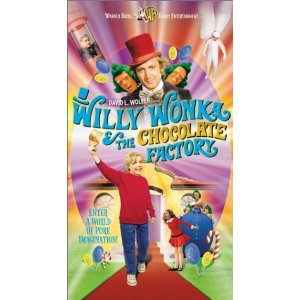
Willy Wonka and the Chocolate Factory

The things you learn when you do an Internet search—like that Willy Wonka and the Chocolate Factory, Mel Stuart’s 1971 classic, was financed by Quaker Oats to promote a new chocolate bar. Hey, come to think of it, I remember those Wonka Bars (and Gobstoppers, and probably a few others) from my 1970s childhood, and now I realize it was all part of a brilliant marketing scheme.

Well, I won’t let that diminish my happy memories of this film, which I recently revisited with George, Pearl and our seven-year-old friend Elliott. Forty years old this year, Willy Wonka and the Chocolate Factory still stirs the imagination and is every bit as weird and wonderful as I remembered it. Based on Roald Dahl’s novel Charlie and the Chocolate Factory, the film delves into some of the darker aspects of human nature, but is buoyed by energetic musical numbers and the clever and nuanced comedy of Gene Wilder as Willy Wonka.

A refresher on the plot: A good-natured boy named Charlie Bucket works to support his family, which includes four bedridden grandparents. When mysterious candy-maker Willy Wonka offers to admit five lucky people inside his factory, Charlie, like every child on the planet, becomes preoccupied with finding one of the “golden tickets” tucked inside a Wonka Bar. With hardly a penny to spare on chocolates, however, his odds seem slim.

Night after night, the TV news reports as the tickets are found, introducing a fantastic cast of despicable child characters: the gluttonous Augustus Gloop, the gum-smacking Violet Beauregarde, the screen-obsessed Mike Teavee, and the icon of rich, spoiled brattiness: Veruca Salt.

After a few suspenseful twists, Charlie finds the last golden ticket and runs home to show his family. On the way, an evil-looking man named Slugworth stops Charlie and promises to make him rich if he will bring him one of Wonka’s Everlasting Gobstoppers. At home, Grandpa Joe miraculously gets out of bed and agrees to join Charlie for the factory tour.

In addition to a prized look behind the scenes, Wonka offers the children a lifetime supply of chocolate, IF they abide by his rules during the tour. As the film progresses, each child meets his or her demise, as their true and terrible natures betray them. Even the lovable Charlie gives in to temptation at one point—but if rule-breaking and deception are inherent to the human existence, the film suggests that better intentions can sometimes rise above, and honesty can lead to redemption.

So, how did the kids like Willy Wonka and the Chocolate Factory? On the whole, they loved it. They were appropriately aghast at the behaviors of the “bad” children, which generated lots of comments, and they easily identified with Charlie, who has to be one of the most sympathetic characters in the history of film. Their favorite part of the movie was clearly the magical moment when the tour arrives at the factory’s interior, with its chocolate stream and everything edible and made of candy. A child’s dream come true!

However, there were a couple of scenes which made me realize this film is not ideal for very young viewers. One of these is the boat ride into the depths of the factory. As Wonka’s boat catapults through a tunnel, disturbing images pop up on the walls: a chicken getting its head cut off, a huge centipede crawling over a man’s face, and the like, as Gene Wilder sings a creepy song. Looking at this scene in light of current moviemaking, the effects seem endearingly clunky, and yet it still packs a punch for young viewers. All three had wide eyes, and three-year-old George ran from the room, thankfully missing most of this scene. I remember doing the same thing! So, if young kids are watching, a fast-forward is advised.

Also, watching each of the misbehaving kids get their comeuppance may be troubling, most notably Augustus Gloop disappearing into the chocolate river and being suctioned up into a tube. The film makes it clear that each kid is unharmed in the end, but still. The kids talked about the tube scene for a few days after.

My overall take: This was a fun film for me in terms of nostalgia and the kids enjoyed it, but I think it is probably more geared to slightly older kids. The site Common Sense Media recommends it for kids age eight and above, and that sounds about right to me too. We will definitely watch it again, but will probably wait a couple of years.

Monday, October 3, 2011

The Red Balloon

Undeniably, The Red Balloon (Le Ballon Rouge) belongs to the canon of classic children’s cinema. Released in 1956 by director Albert Lamorisse, this half-hour film tells the story of a young boy (Lamorisse’s own son Pascal) and his unusual friendship with a red balloon that follows him through the streets of Paris. The only short film ever to win an Oscar for best original screenplay, The Red Balloon has been enjoyed by generations. I saw it as a child and was excited to share what I remember as a magical story with my own kids.

True to my memory, the film is magical. George and Pearl were quickly enchanted by the puppy-like antics of the balloon as it traipsed after young Pascal, following him home and later to school. There is virtually no dialogue, making it a very accessible international film.

Told through images, the storyline is both sweet and emotionally wrenching. Much as in Lamorisse’s White Mane, the child protagonist in The Red Balloon is portrayed as lonely and persecuted. The only image of his home life is of an angry mother casting his balloon out the window. Fortunately for Pascal, his balloon obediently waits outside for him. The scenes of his school show a cruel principal who locks Pascal up in a closet all day for bringing his balloon (it causes a distraction for the other children).

But by far the worst he must endure is a marauding pack of feral schoolboys who chase Pascal through the city’s mazelike streets and passageways, trying to destroy his balloon with rocks. In the end, they succeed in separating Pascal from the balloon and one boy hits the target with a slingshot. Slowly the balloon deflates and dies. These scenes were disturbing to all of us, but especially to three-year-old George—something parents of young kids may want to consider.

As sad as the balloon’s passing may seem, the film deals with issues that all kids face. Balloons pop, and throughout life, loss happens—both big and small. Sometimes we feel lonely and like no one is on our side. But I contend that the greatest works of children’s film and literature deal with these themes, as difficult as they are. The final scenes of the film are ultimately redeeming: Balloons from all over the city take flight and come to Pascal’s aid. The film’s last shot is truly uplifting, and I’ll leave it at that.

While dealing with some of life’s big themes, The Red Balloon’s premise is relatively simple, as are the special effects—a surprisingly believable simulation in which the balloon really does seem to move of its own accord. We had some discussion of how the filmmaker might have pulled this off (unseen wires?)—which made me realize that in more modern films where special effects are much more technical, we don’t often talk about how the film was made. Perhaps because I don’t even know! I liked this aspect of The Red Balloon, and it made me think about how we might someday try to make our own film with homemade special effects.

Visually, the film is stunning. The contrast of the bright red balloon and the gritty urban backdrop reflects Lamorisse’s cinematic prowess.  The film also provides a fascinating documentation of mid-Century Parisian street life and an impoverished neighborhood of Ménilmontant that was mostly demolished in the decades following.

Want to watch it? The Red Balloon is available for purchase as part of the Criterion Collection. We checked it out from our local library.

Tuesday, September 20, 2011

The Black Stallion


Riding on the heels (hooves?) of White Mane, I really wanted the kids to see a favorite horse movie from my own childhood, The Black Stallion. Released in 1979, the film is based on Walter Farley’s classic book series of the same name. Legendary film critic Pauline Kael once said, The Black Stallion “may be the greatest children's movie ever made.” And while such claims are always arguable, one can’t deny this movie is stunningly beautiful, well acted, and truly captivating.

Set in 1946, the story begins on a cruise ship sailing off the coast of North Africa. Wandering the ship at night while his father plays cards, a young passenger named Alec discovers a black horse onboard in a makeshift stable. The horse bucks and fights against his rope restraints, held by a group of shouting men. Alec later brings the horse some sugar cubes, pushing them through a small window. The men are gone, and the wild horse gently takes Alec’s offering.

Later that evening, Alec and his father are awakened when the ship begins to pitch and fill with water. A fire breaks out onboard, and in the chaos Alec cuts the horse free from its restraints, the horse jumps overboard, and Alec himself is thrown from the ship. Struggling in the dark waters, illuminated by the raging fire, Alec grabs on to the horse’s ropes, while in the background the burning ship goes down.

This was definitely a frightening scene for the kids, especially when Alec becomes separated from his father, who is trying to help him to safety, but also feels compelled to help put out the fire. Some may find the opening scenes too scary for their kids, in which case you can always fast forward.

We watched the whole scene, and to me the most disturbing part was when one of the men who had been restraining the horse violently snatches Alec’s life vest from him—a true “bad guy” move. Also problematic about this scene: The guy is Arab, wears a turban, and I am sensitive to the kids’ exposure to portrayals of people of different races or cultures as evil. Note to self: Find positive portrayals of Arab people in other films.

In the end, Alec and the horse are the only survivors from the ship, and both end up on a deserted island. So begins the best part of this film, and what I most remember from watching it as a child over 30 years ago. Alec must contend with the loss of his father, his aloneness, and his need to survive in a completely foreign environment. Wandering the island, he discovers the stallion caught up in its own ropes among rocks. Alec again frees the stallion and it runs off. The scenes that follow show Alec’s patient, clever, and gentle efforts to tame the stallion, set against the stunning natural backdrop of the island.

As Alec is alone, there is no dialogue for a long section of the film, and compared to many children’s films, the pacing is slow—beautifully slow. The cinematography during the island scenes is gorgeous, with very memorable scenes of Alec and the stallion running together along the beach, and one especially exciting scene where the stallion rescues Alec from a deadly cobra.

Finally, Alec is rescued by some fishermen and insists that the horse come with him. He returns home to his mother in the U.S., and another chapter begins as he befriends a retired jockey (Mickey Rooney), who trains Alec and his horse (whom he names “The Black”) to race. The second half of the film, while also shot and acted with skill, unfolds with a fairly predictable story, a highly implausible race in which the young boy, in a mask, rides “the mystery horse” and (you guessed it) wins!

I found my attention waning, but the kids were enthralled. I don’t think either of them had ever seen a horse race, even on TV, so this was very exciting to them, as was the idea of young Alec working hard and training to compete with far more experienced adults.

But most importantly, as in White Mane, the friendship between boy and horse in The Black Stallion is well developed and offers a touching and compelling story that I imagine all kids would enjoy and relate to.

In fact, I’d better watch out with the horse movies, or requests for riding lessons may be in our future!

Sunday, September 18, 2011

White Mane (Crin Blanc)

First up in our exploration of classic children’s cinema: White Mane. Directed by Albert Lamorisse, this acclaimed 1952 black and white, French language film won the Palme d’Or at the Cannes Film Festival and has been revered as a classic of French cinema. It is available as part of the Criterion Collection.

All this means nothing to the kids, though. As the opening credits rolled, my six-year-old daughter, in her new going-on-thirteen voice, demanded, “Is it ALL in black and white? Is it going to be BORING?” Just watch, just watch and see, I said.

In no time at all, she and her almost three-year-old brother and seven-year-old friend were completely engrossed. The film is in French, so I read the subtitles out loud. Dialogue and narration are both sparse, so this wasn’t an issue. As for black and white and boring, also not an issue. The film has lots of intrigue and action and at times is even quite tense.

The story takes place in the south of France, in a stark but beautiful landscape of marshland, in a region called the Camargue. There, a magnificent stallion, White Mane, leads a herd of wild horses who roam the land, evading capture by a dogged group of ranchers on horseback.
Nearby, a boy named Folco lives in an isolated shack with his grandfather and baby brother. Folco identified in the narration as “the young fisherman” is shown alone on his skiff, fishing and making his way across the marsh. 

My kids were intrigued by the idea of a young boy so independent and with real responsibilities. In one scene, Folco arrives home to his shack and brings his little brother a turtle, and in another he captures a rabbit and cooks it over an open fire. These documentary-like scenes of the boy’s everyday life definitely piqued my kids’ interest. Then of course there are the many beautifully shot scenes of wild horses—what kid would not love these?

Ultimately, the ranchers fail to break White Mane and young Folco befriends and tames the stallion through sheer determination and a healthy dose of kindness. However, beyond the touching bond between boy and horse, the film delves into darker territory, showing that adults can be cruel, deceptive, and ruthless in their pursuits. We were all on edge through several scenes as the marauding men on horseback chased White Mane, even setting a raging grass fire to drive him out. In one scene, White Mane and a rival stallion engage in a violent and very real fight, kicking and biting each other bloody. In this scene, the black and white film is a particular blessing.

The darkest moment, though, is the ending, in which (spoiler alert!) the men chase Folco and White Mane to a point where a river meets the ocean, and the two are swept out to sea, presumably to their deaths. I was shocked at this seemingly pessimistic ending to a children’s film. Yet, at the same time, the final scene was poetic, and the kids were far less bothered by it than I was. The narrator states that White Mane took Folco to a far-away land where men and horses could live as friends, and the kids took this information literally. To a child, who lives in a world of fantasy, the ending could be seen as magical and comforting. The adult viewer, however, will more likely feel the deeper emotional impact of watching a boy and his horse being swallowed by crashing waves. That is part of the genius of this film.

Our final take: The kids and I really, really liked White Mane, and it gave us much to talk about, raising questions around wild horses and the boy’s lifestyle, as well as more philosophical concerns about what propels men to pursue the unattainable, and why they need to “break” a wild animal. Ultimately this film is a true work of art, and I look forward to watching Albert Lamorisse’s other children’s classic of the same era, The Red Balloon, very soon. More on that another day…